
How to Choose the Right Farm Fertilizer?
Choosing the right farm fertilizer begins with understanding what your soil and crop actually need. A green field can still hide a nutrient shortage, while excess fertilizer may wash away or remain unused. Soil tests provide a useful starting point, but they do not tell the whole story. Crop history, expected yield, local rainfall, and application timing also matter.
Soil scientist William A. Albrecht is often credited with saying, “The health of the soil, the plant, the animal and man is one and indivisible.” His words point to a practical truth: fertilizer decisions affect more than this season’s harvest. A soil test showing low phosphorus, for example, may call for a different product and rate than a field short on nitrogen. Read the test carefully. Check its date, sampling depth, and recommendations for the crop you plan to grow.
The right choice is rarely a single product for every field. Compare nutrient grades, application methods, and product costs per unit of nutrient—not just the price per bag. Keep records of rates and results, then review them after harvest. That step is easy to skip. I have to admit, fertilizer labels can make a simple decision feel more certain than it is. Treat recommendations as a starting point, and consult a qualified local agronomist when results or field conditions are unclear.
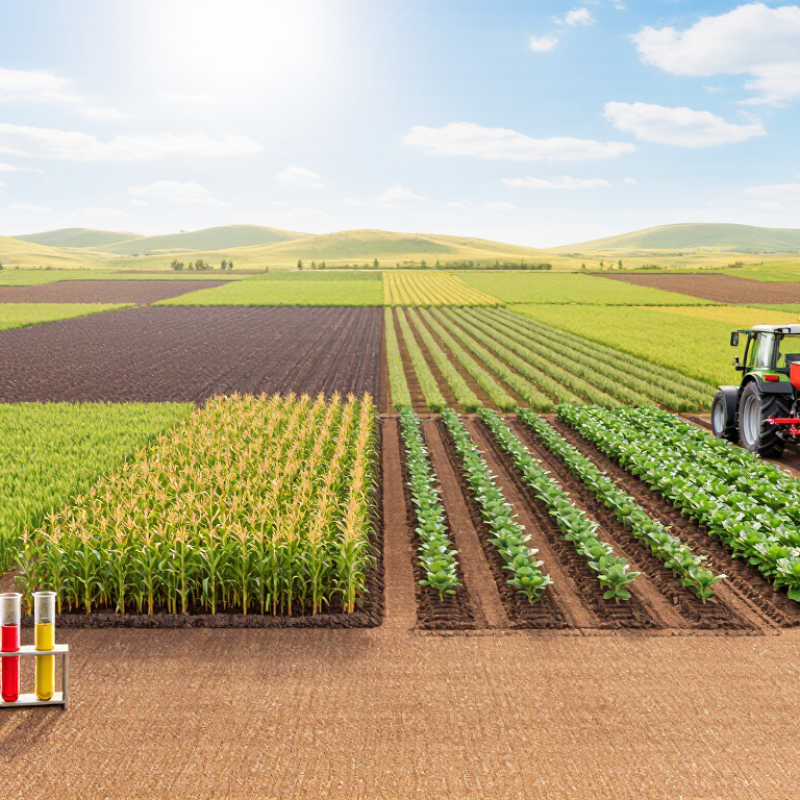
Assess Crop Nutrient Needs and Field Conditions
Choosing farm fertilizer starts with the crop, not the bag. Test soil before planting, and sample separate field zones where soil color, slope, or past yields differ. A lab report can reveal pH and available nutrients; a field walk cannot. Compare results with crop-specific recommendations and realistic yield goals. Roots need the right nutrients, in the right amounts, at the right time.
Field conditions change the plan. Sandy soil may lose nitrogen quickly after heavy rain, while compacted ground can restrict root access to nutrients. Check drainage, residue, irrigation water, and recent manure applications.
The FAO’s World Fertilizer Trends and Outlook to 2026 projected global nutrient demand of about 208.5 million tonnes in 2026. That is a broad market estimate, not a field prescription. Local soil tests matter more. I still double-check them. Sampling depth or timing can skew results, and one imperfect sample may mislead.
Tips: Keep a simple field record: test date, sampling spots, crop, fertilizer rate, and yield. Follow your local extension service’s guidance for sampling and nutrient timing. Retest when conditions or crop plans change. Don’t assume last year’s rate still fits.
Test Soil to Identify Nutrient Levels and pH
Before choosing a farm fertilizer, test representative soil instead of guessing from leaf color. Nutrient symptoms can overlap. A yellow lower leaf may suggest nitrogen shortage, but waterlogged roots can look similar. Sample field zones separately when slope, crop history, or manure use differs. Use a clean probe and collect 10–15 cores from the recommended sampling depth. Mix them in a clean bucket. Avoid headlands and fertilizer bands. Small details matter.
Send a dry, mixed sample to a qualified soil laboratory. Request pH, organic matter, phosphorus, potassium, and nutrients relevant to your crop and region. Ask how the lab’s recommendations account for crop type and expected yield. Soil pH affects nutrient availability, but suitable ranges vary by crop. Lime or sulfur decisions should reflect measured pH and, where available, buffering capacity. One sample can still miss field variation. That is easy to overlook.
Compare results with past tests and field records before selecting a fertilizer blend. If phosphorus is already high, adding more may raise costs without fixing the actual problem. Retest using a consistent sampling depth and season when possible. Soil tests guide decisions; they do not guarantee yields. Unusual patches may need separate samples. Testing can feel slower than spreading fertilizer today, but it may help avoid an expensive correction later.
How to Choose the Right Farm Fertilizer?
Test soil to identify nutrient levels and pH
Example soil pH: 6.2 (slightly acidic)
This illustrative soil test reports nitrate-nitrogen, Olsen phosphorus, and exchangeable potassium in mg/kg. Test methods and crop needs affect how results should be interpreted. A pH of 6.2 is suitable for many crops, but check the requirements of your specific crop and use a local soil-test recommendation before choosing fertilizer.
Compare Fertilizer Nutrients, Forms, and Sources
Choosing farm fertilizer starts with what the soil and crop actually need. A recent soil test can reveal nutrient shortages, pH concerns, and existing reserves. The three numbers on a fertilizer label show nitrogen, phosphate, and potash content. Nitrogen supports leafy growth, while phosphorus and potassium contribute to roots, flowering, and plant function. Needs vary by crop and growth stage. Guessing can waste money.
Fertilizers come in different forms. Granules are easy to spread across larger fields and may release nutrients gradually, depending on their formulation. Liquid products can be useful for precise applications, but they require suitable equipment and careful calibration. Small differences matter. Keep the application rate, weather, and irrigation method in mind; nutrients can move or become less available under certain conditions.
Sources also differ. Mineral fertilizers provide specified nutrient amounts, while manure and compost add organic matter and release nutrients at variable rates. Their nutrient content can vary between loads, so testing is useful before application. It is tempting to choose a product by its N-P-K numbers alone. That misses timing, soil conditions, and handling. A practical comparison includes nutrient concentration, release speed, transport cost, and how evenly the material can be applied. Sometimes, the simplest choice is not the best one.
How to Choose the Right Farm Fertilizer? — Compare Fertilizer Nutrients, Forms, and Sources
| Fertilizer Material | Typical Analysis (N–P2O5–K2O) |
Main Nutrients and Forms | Source or Material Type | Common Uses | Key Considerations |
|---|---|---|---|---|---|
| Urea | 46–0–0 | Nitrogen in amide form; soil microbes convert it to ammonium and then, under suitable conditions, nitrate. | Manufactured nitrogen fertilizer | Pre-plant, side-dress, or top-dress nitrogen applications for many field crops. | Surface-applied urea can lose nitrogen as ammonia, especially on warm, moist, high-pH soils. Incorporation, rainfall, or an appropriate urease inhibitor can reduce this risk. |
| Ammonium Nitrate | 34–0–0 | Nitrogen is present as both ammonium-N and nitrate-N. | Manufactured nitrogen fertilizer | Rapid nitrogen supply where both immediately available nitrate and ammonium are useful. | Nitrate can move with drainage water. Product availability and handling requirements vary by location; follow local regulations and label directions. |
| Diammonium Phosphate (DAP) | 18–46–0 | Ammonium-N and predominantly plant-available phosphate, reported as P2O5. | Manufactured ammonium phosphate | Supplies starter nitrogen and phosphorus, commonly in pre-plant or banded applications. | Keep concentrated fertilizer bands from direct contact with seed when rates or soil conditions may cause injury. Use soil-test recommendations for phosphorus rates. |
| Monoammonium Phosphate (MAP) | 11–52–0 | Ammonium-N and predominantly plant-available phosphate, reported as P2O5. | Manufactured ammonium phosphate | Provides phosphorus with a modest amount of nitrogen; used in starter and pre-plant programs. | As with other concentrated phosphate fertilizers, placement and rate matter near seed. Select MAP or DAP based on nutrient needs, soil conditions, and local recommendations. |
| Monoammonium Phosphate, Potassium-Chloride Form (Muriate of Potash) | 0–0–60 | Potassium, reported as K2O, supplied mainly as potassium chloride. | Mineral-derived potassium fertilizer | Corrects potassium deficiency and supplies potassium to crops with a soil-test-based need. | Contains chloride and has a relatively high salt concentration. Consider crop sensitivity, soil salinity, application rate, and placement. |
| Potassium Sulfate (Sulfate of Potash) | 0–0–50 | Potassium, reported as K2O, plus sulfur in sulfate form; a typical grade contains about 17% sulfur. | Mineral-derived potassium sulfate fertilizer | Supplies potassium and sulfur, including in situations where chloride input should be limited. | Usually costs more per unit of potassium than potassium chloride. Check the product analysis and compare nutrient cost and crop requirements. |
| Ammonium Sulfate | 21–0–0 about 24% S |
Ammonium-N and sulfate-S, both supplied in readily available forms. | Manufactured nitrogen-sulfur fertilizer | Provides nitrogen and sulfur where both are needed; may be useful in some high-pH soil management programs. | Repeated use can acidify soil. Account for its nitrogen and sulfur when planning the full nutrient program and monitor soil pH. |
| Gypsum | 0–0–0 about 23% Ca, 18% S |
Calcium and sulfate-sulfur; does not supply nitrogen, phosphorus, or potassium. | Calcium sulfate mineral amendment | Supplies calcium and sulfur; can be used for specific soil or sodicity management needs when supported by testing. | Gypsum is not a substitute for lime when the goal is to raise soil pH. Base use and rate on soil tests and local guidance. |
| Composted Manure | Variable | Organic nitrogen, phosphorus, and potassium; nutrient release depends on material, maturity, soil, and weather. | Composted livestock manure and bedding | Adds organic matter and nutrients; may contribute to long-term soil improvement when applied appropriately. | Analyze each source before use. Nutrient ratios may not match crop needs, and repeated applications can build soil phosphorus or salts. Follow food-safety and local application requirements. |
Selection tip: Start with a representative soil test and crop nutrient requirements. Typical analyses are approximate; verify the guaranteed analysis on the product label and follow local agronomic recommendations. Fertilizer labels generally express phosphorus and potassium as P2O5 and K2O, not elemental P and K.
Calculate Application Rates and Choose Timing
A sound application rate starts with a recent soil test, a realistic yield goal, and the crop’s nutrient needs. Use the recommendation for each nutrient, not a generic “one bag per acre” rule. For example, a plan calling for 120 pounds of nitrogen per acre requires about 261 pounds of 46% nitrogen urea per acre: 120 divided by 0.46. Check the spreader calibration, too. A small setting error can cover many acres before it becomes obvious.
Timing matters just as much. USDA NRCS Nutrient Management Standard 590 calls for nutrient decisions based on soil and crop needs, with attention to application method and risk of nutrient loss. FAO’s World Fertilizer Trends and Outlook to 2022 projected global demand of 199.1 million tonnes of nitrogen, phosphate, and potash combined for 2022—a reminder that nutrients are widely used, but not a reason to overapply. Apply nutrients near periods of crop uptake, and avoid spreading before heavy rain or onto saturated ground. Split nitrogen applications where local guidance supports it. Keep records of dates, rates, field conditions, and yield. I still double-check the math. It is easy to confuse product weight with nutrient weight, especially when the field is waiting and the weather is turning.
Evaluate Cost, Handling, and Environmental Impact
How to Choose the Right Farm Fertilizer?
Evaluate Cost, Handling, and Environmental Impact
Fertilizer choice is a field decision, not a bag-price contest. Compare cost per unit of available nutrient, including freight, storage, spreading, and extra passes. USDA ERS estimated U.S. farm spending on fertilizer and lime at $36.8 billion in 2022 (Farm Income and Wealth Statistics). A cheaper ton may cost more if it supplies less nutrient or needs repeated application. Check the analysis against a current soil test.
Handling matters on busy days. Damp granules can cake in a hopper, while dusty products may drift during loading. Confirm storage needs, spreader settings, and whether the material flows evenly before buying at scale. Small details matter. A small calibration error across several fields can mean uneven crop growth and wasted product.
Environmental impact depends on rate, timing, placement, soil, and weather. Avoid spreading before heavy rain when runoff could carry nutrients into ditches or streams. FAO’s World Fertilizer Trends and Outlook to 2022 projected global demand of 201.7 million tonnes of fertilizer nutrients for that year. That projection signals the scale of nutrient use, not a recommended rate for any farm. No spreadsheet captures every wet spring; local soil tests and field conditions still deserve the final say.
Related Posts
-
How to Speak Fertilizer with Global Suppliers?
-

How to Choose the Best Farm Fertilizer for Your Crops?
-

China Top 10 Ag Fertilizer Suppliers for Global Buyers?
-
Why Speak to a Fertilizer Supplier Before Buying?
-
How to Choose the Best Field Fertilizer for Your Crops
-
2026 Top Field Fertilizer Types for Optimal Crop Growth?